
How DJs Stop That Awful Mic Feedback
You know the sound. Somebody grabs the mic for a heartfelt toast and — SCREEEECH — the whole room grabs their ears. That ear-splitting squeal is feedback, and it can flatten a beautiful moment in half a second. The good news? Preventing feedback is mostly about smart setup, not luck. A pro DJ uses a handful of simple tricks to kill the squeal and howl before it ever starts. Let’s pull back the curtain on how it’s done, so your speeches stay warm and clear all night.
In this article
What feedback actually is
Let’s start with the why, because it makes everything else make sense. Feedback is just a loop. The mic picks up sound from the speaker, sends it back through the speaker, picks it up again, and around it goes — louder each lap — until you get that awful screech.
So preventing feedback really means breaking that loop before it can build. Once you picture it as a circle of sound feeding itself, the fixes are obvious: keep the mic from “hearing” the speakers, and don’t give any one tone room to run wild.
Here’s the encouraging part. Feedback isn’t random or spooky. It follows clear rules, which means a prepared DJ can head it off with setup choices made before a single guest walks in. It’s a solved problem — when the right person is running the room.
It also helps to know that feedback likes certain conditions. A mic turned up too high, a speaker aimed the wrong way, or a hard, echoey room all make it more likely. Flip any one of those and the risk drops. So the whole job is really just stacking up small advantages until that loop can’t get going at all.
Speaker and mic placement
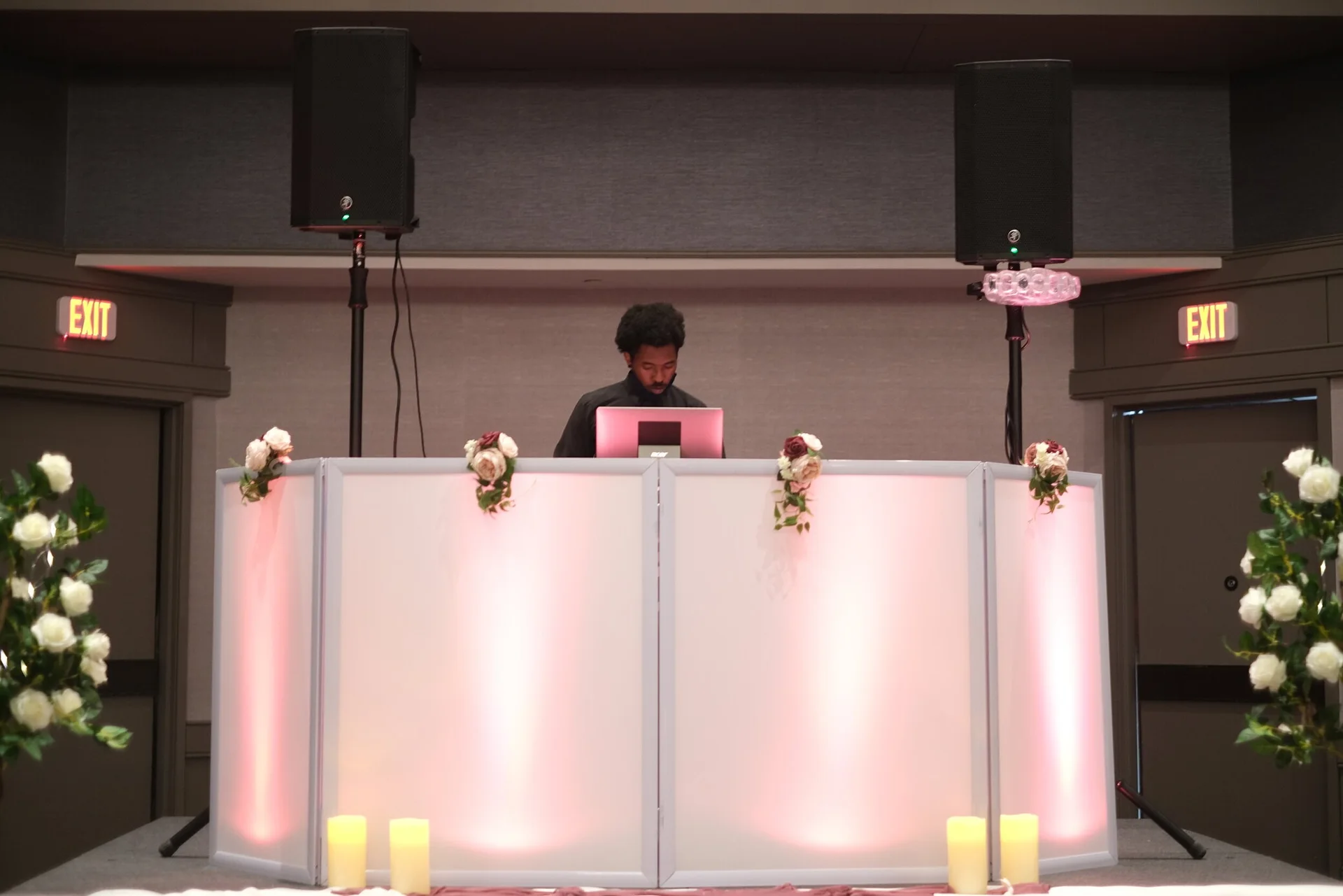
The single biggest trick is also the simplest: keep the microphone in front of the speakers, never behind them. When the speakers point away from the mic, that feedback loop has a much harder time forming. Half the battle is won right there.
That’s why you’ll see a pro set the main speakers ahead of where the toasts happen, aimed out at the crowd. The mic stays behind that line of fire. Simple geometry does the heavy lifting before any fancy gear gets involved.
Distance matters too. A mic held right up near a speaker is asking for trouble, while one kept at a sensible distance stays calm. So when the best man wanders toward a speaker mid-toast, a good DJ is already easing the level down to keep things smooth. It’s quiet, constant attention that guests never notice.
Tuning the room with EQ
Every room has a few “problem tones” — specific pitches that want to ring out and start feedback. Think of them as the weak spots in the room’s armor. A good DJ finds and softens them before the party starts.
The tool for this is EQ, which just means turning certain tones up or down. Before guests arrive, I’ll gently push the system until a tone starts to ring, then pull that exact tone back down. Do that for the handful of trouble spots and the whole room gets a lot more forgiving. It’s like rounding off the sharp corners.
This “ringing out the room” takes just a few minutes, but it makes a massive difference. It’s the kind of prep work you’d never see as a guest, yet it’s the reason the toasts sound clean. According to WeddingWire’s guidance on wedding audio, room tuning and mic handling are two of the biggest factors in speeches that actually sound good.
Feedback isn’t random or spooky — it’s a loop that feeds itself. Break the loop before it builds, and the screech never gets a chance to start.
The right mic and how to hold it
Not all microphones are created equal. Some are built to hear sound from every direction, which is great for a podcast but a nightmare at a loud reception. Others are designed to hear mostly what’s right in front of them — and those are the ones you want.
A directional mic naturally ignores the speakers off to the side, so it fights feedback for you. Pair that with a little coaching on how to hold it — close to the mouth, pointed at the chin, not waved around like a wand — and speeches get dramatically clearer. Most feedback at DIY events comes from a great mic held the wrong way.
I always give a quick, friendly tip to anyone giving a toast: keep the mic close and speak across the top of it. Ten seconds of guidance saves the moment. If you want the full picture of how the mic, sound, and flow work together on the day, my wedding DJ services page breaks it all down.
There’s a comfort payoff here, too. When the mic sounds clean and easy, nervous speakers relax, because they can hear themselves clearly and aren’t fighting the room. That means better toasts, not just quieter ones. A good mic setup quietly makes everyone who steps up to it sound like they know what they’re doing.
Key takeaway: Feedback is a sound loop you can break with three moves — put speakers ahead of the mic, tune the room’s problem tones with EQ, and use a directional mic held close. Do those before guests arrive and speeches stay crystal clear.
Catching it live before it screams
Here’s what a lot of couples miss: even with perfect setup, a live room keeps changing all night. People move, the crowd shifts, someone carries the mic to a new corner. So preventing feedback isn’t a one-and-done job — it’s something a DJ watches for the whole event.
A trained ear catches the very first hint of a ring, a fraction of a second before it turns into a full screech. In that instant, a quick nudge of the level or a small EQ tweak shuts it down before anyone hears more than a blip. Guests never even know it almost happened.
That live attention is the difference between a machine and a person. Automatic gear helps, but nothing beats someone who’s actually listening and ready to react. It’s the reason a pro-run mic feels effortless while a set-and-forget system eventually squeals. For more behind-the-scenes tips like this, browse more wedding tips whenever you like.
Why DIY setups squeal most
Ever been to a party where every toast started with a screech? There’s almost always a reason, and it’s rarely bad luck. It’s a rented speaker parked in a corner with a mic nobody tuned, and no one watching the levels.
A DIY setup skips all the quiet prep work. The speakers end up wherever there’s room, the mic is whatever came in the box, and nobody rings out the space beforehand. So the first loud toast finds every weak spot at once, and the room pays for it with that ear-splitting howl.
The fix isn’t more expensive gear — it’s the know-how to set it up right and the attention to keep it right. That’s exactly what a pro brings. The equipment matters, sure, but the person running it matters more. Anyone can plug in a speaker; not everyone can keep it silent when it counts.
If you ever do end up running your own sound for a small event, a couple of habits go a long way: keep the mic well in front of the speakers, and don’t crank the volume higher than you truly need. Planning guides like Zola’s ceremony sound tips stress those same basics, because they head off most feedback before it ever starts. Simple moves, big difference.
A clear mic for your Sterling Heights day
So what does all this mean for your celebration? It means your toasts, your vows, and your big announcements come through warm and clear — no screech, no scramble, no cringe. That’s the whole goal of preventing feedback in the first place.
Whether you’re gathering at a banquet hall off Hall Road, celebrating near the Clinton River, or dancing in a tented backyard in Sterling Heights, the standard holds: speakers placed right, room tuned early, a directional mic held close, and a real person listening all night. Get those pieces in place and the mic simply behaves.
Ceremonies deserve the same care as receptions, by the way. Vows are often soft-spoken, and outdoor ceremonies add wind and open space to the mix. A pro plans mic placement for those quiet, tender moments just as carefully as for the loud dance set — because that’s the part guests lean in to hear.
If you’d like to see how the whole day flows, take a peek at my Sterling Heights wedding guide, or meet your DJ and we’ll make sure every word lands clean. Your moment deserves to be heard — not drowned out by a squeal.