Setting Up Toasts: Your MC’s Job
We’ve all sat through it — the toast that rambles for ten minutes while dinner goes cold and guests check their phones. Here’s the thing: that almost never happens because of a bad speaker. It happens because nobody set the toast up right. Setting up toasts is your MC’s job, and it’s the quiet skill that decides whether speeches land warm and tight or drift into awkward. A good emcee frames each speaker, cues the room, and keeps things moving so every toast feels like a highlight instead of a hurdle. Here’s exactly how I do it at a Rochester Hills reception, and how the right setup makes even nervous speakers shine.
In this article
Why the setup matters more than the speech
Let’s start with a truth most couples never hear. The words a speaker says matter less than the moment they say them into. A great speech dropped into a chaotic room falls flat. A simple, heartfelt one dropped into a warm, ready room feels magical.
That’s why setting up toasts is where the real work lives. Before a single word is spoken, the MC has to get the room quiet, the glasses filled, the speaker mic’d, and the mood right. Skip any of that and even the best toast stumbles out of the gate.
Think of the MC as the frame around a painting. The speech is the art, sure — but the frame is what makes everyone stop and look. Get the frame right and the picture shines. That’s the job, and it’s mostly invisible when it’s done well.
How an MC frames each speaker
Here’s where a pro earns their keep. Framing a speaker means giving the room a reason to care before the person even starts. A good intro does three quick things.
It names the relationship. “Please welcome the bride’s sister and maid of honor” tells the room who’s talking and why they matter. Instant context.
It sets the tone. A warm, upbeat intro tells guests this is a happy moment, so they lean in with a smile instead of bracing for a lecture.
It hands off cleanly. A clear “the floor is yours” and a smooth pass of the mic means no fumbling, no “is this on?”, no dead air. The speaker starts strong because I set them up to.
Good framing also protects the couple. If a speaker starts to wander somewhere the room shouldn’t go, a warm, well-timed intro has already set expectations for something kind and short — and I can gently steer things back on track from the side. The setup isn’t just a courtesy; it’s a safety net for the whole moment.
That handoff sounds small, but it’s everything. When a speaker takes the mic already feeling supported, their nerves drop and their words flow. A good emcee makes the person up there feel like the room is on their side — because it is.
The right order and timing for toasts
Order matters more than you’d think. A good sequence builds emotion instead of scattering it. My go-to flow is simple and it works almost every time.
I like to start with the welcome — often a parent or the couple thanking everyone for coming. Then the best man and maid of honor, the fun and heartfelt ones. Then, if the couple wants, a few words from the newlyweds to close. That order rises from warm to funny to touching, and it leaves the room glowing right as dinner wraps.
Timing is just as key. The sweet spot for toasts is usually after the main course is served but before dessert, when people are fed, settled, and paying attention. Too early and folks are still finding seats. Too late and the energy’s already turned toward dancing. According to The Knot’s guide to toast order, a clear sequence keeps the whole room emotionally on track.
A toast isn’t just a speech — it’s a moment the whole room shares. The MC’s job is to build that moment so every word lands where it’s supposed to.
Here’s what a lot of couples miss: they think toasts just “happen” whenever. But a floating, unplanned toast schedule is how you end up with cold food and a restless room. A quick plan — who speaks, in what order, and when — is the difference between a highlight and a slog. I sort this out with couples weeks ahead so nothing’s a surprise on the day.
Key takeaway: Setting up toasts is the MC’s craft, not luck. Frame each speaker with a warm intro, run them in a rising order, time them after the main course, and handle the mic and cues so speeches land tight and heartfelt. The setup matters more than the words.
Keeping toasts short without being rude
Now the tricky one: the long-winded speaker. You can’t exactly grab the mic away from Uncle Dave. But a good MC has gentle tools to keep things moving, and none of them embarrass anyone.
The best tool is prevention. When I confirm speakers ahead of time, I kindly suggest a two-to-three-minute target and explain that shorter toasts hit harder. Most people are relieved to hear it — they were nervous about length anyway. A little guidance up front saves everyone.
In the moment, I use soft cues. A warm round of applause at a natural pause invites a graceful wrap-up. A gentle step toward the speaker with a smile signals “beautiful, let’s land it.” These moves are invisible to guests but crystal clear to the speaker. Nobody feels rushed, yet the toast still ends on time. If you want to see how this fits into the whole reception, my wedding DJ and MC service page walks through how I run the mic all night.
Calming a nervous speaker
Public speaking scares most people, and a wedding crowd makes it worse. So part of setting up toasts is settling nerves before the speaker ever stands. A calm speaker gives a better toast, every single time.
I find the speakers early in the night and check in. A quick, friendly word — “you’ve got this, I’ll introduce you and hand you the mic, just talk to the couple like nobody else is here” — works wonders. Knowing exactly what’s about to happen kills half the fear.
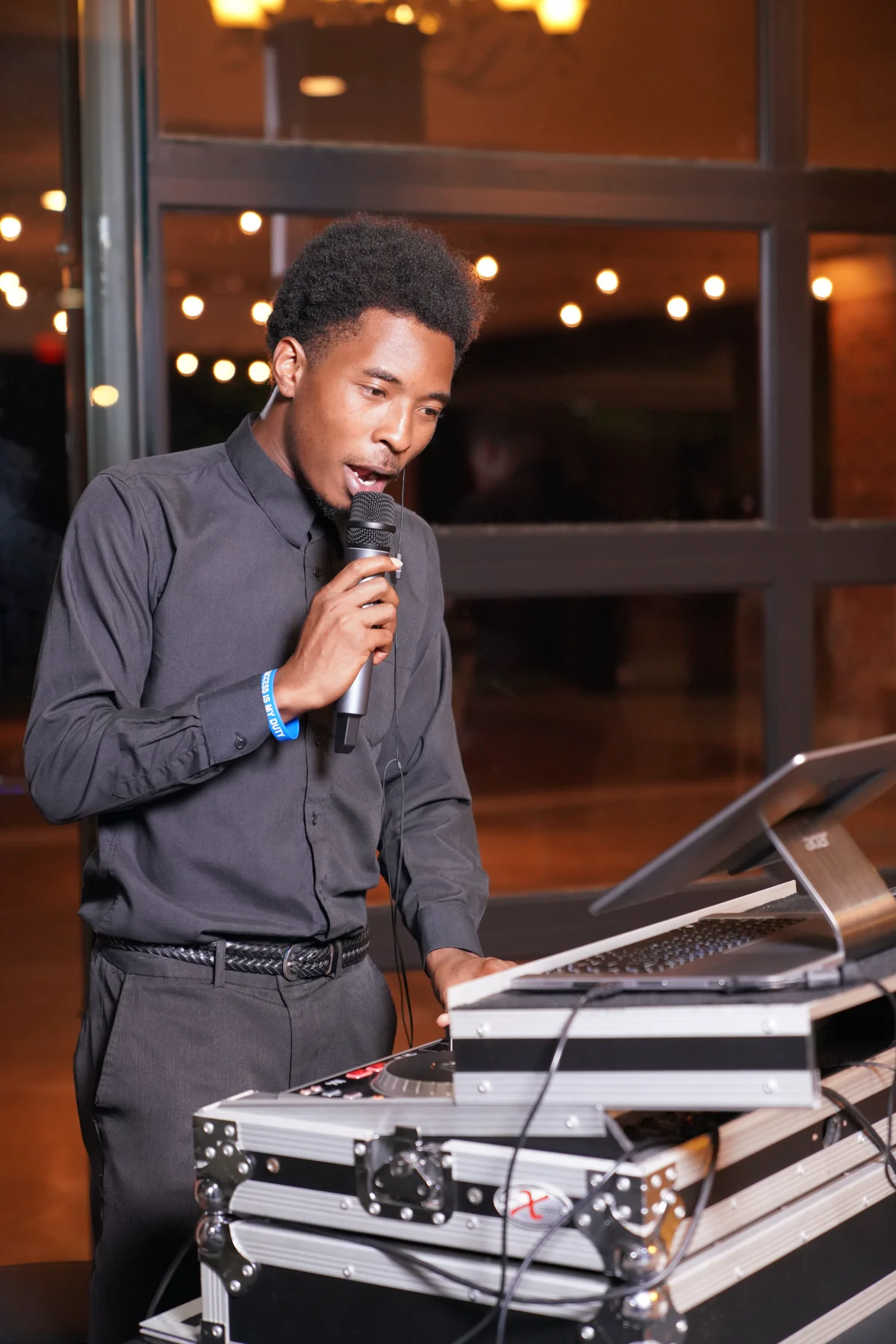
The mic handoff matters here too. I make sure the speaker is holding the mic right and can hear themselves before they start, so there’s no jarring feedback or fumble to spike their nerves. Little things like that let a shaky speaker settle in and find their feet. By the second sentence, they’ve usually forgotten to be scared.
The tech that makes or breaks a toast
None of this works without solid sound. A toast lives or dies on whether the room can actually hear it. Muffled audio turns a sweet speech into a mystery, and no amount of good framing fixes a bad mic.
So I use a reliable wireless mic, set the levels for each speaker’s voice, and place speakers so every table hears clearly — even the back corner near the doors. I also keep a backup mic ready, because gear can hiccup and a dead mic mid-toast is nobody’s idea of fun.
Music plays a quiet role too. A soft bed of background music under a toast, faded in and out at the right moments, adds warmth without stealing focus. Cut it too loud and it competes; leave it dead silent and the room feels tense. Getting that balance right is part of the craft, and it’s why the same person handling music and mic makes the whole thing smoother.
Planning toasts for your Rochester Hills wedding
So how do you set your own toasts up for success? Start by picking your speakers early and sharing the order with your MC. A short list — three or four speakers — almost always beats a long open-mic that drags.
Next, talk timing with your DJ. Whether you’re celebrating at a banquet hall off Rochester Road, a golf-club venue near Avon, or a garden spot elsewhere in Rochester Hills, the same rule holds: toasts after the main course, framed and cued by your emcee, kept warm and tight. Give your MC the details and let them run the moment.
Most of all, choose someone who treats the mic as a craft, not an afterthought. The right emcee turns speeches into the emotional peak of your night. Want to see how I approach it? You can meet your DJ and MC, or read my Rochester Hills wedding guide for the full picture. And if you’re gathering ideas, browse more reception tips whenever you like — the pros over at Zola’s toast advice have some great speaker prompts too.
At the end of the day, a toast should make people laugh, tear up, and raise a glass — all in about three minutes. Set it up right, and that’s exactly what you get.