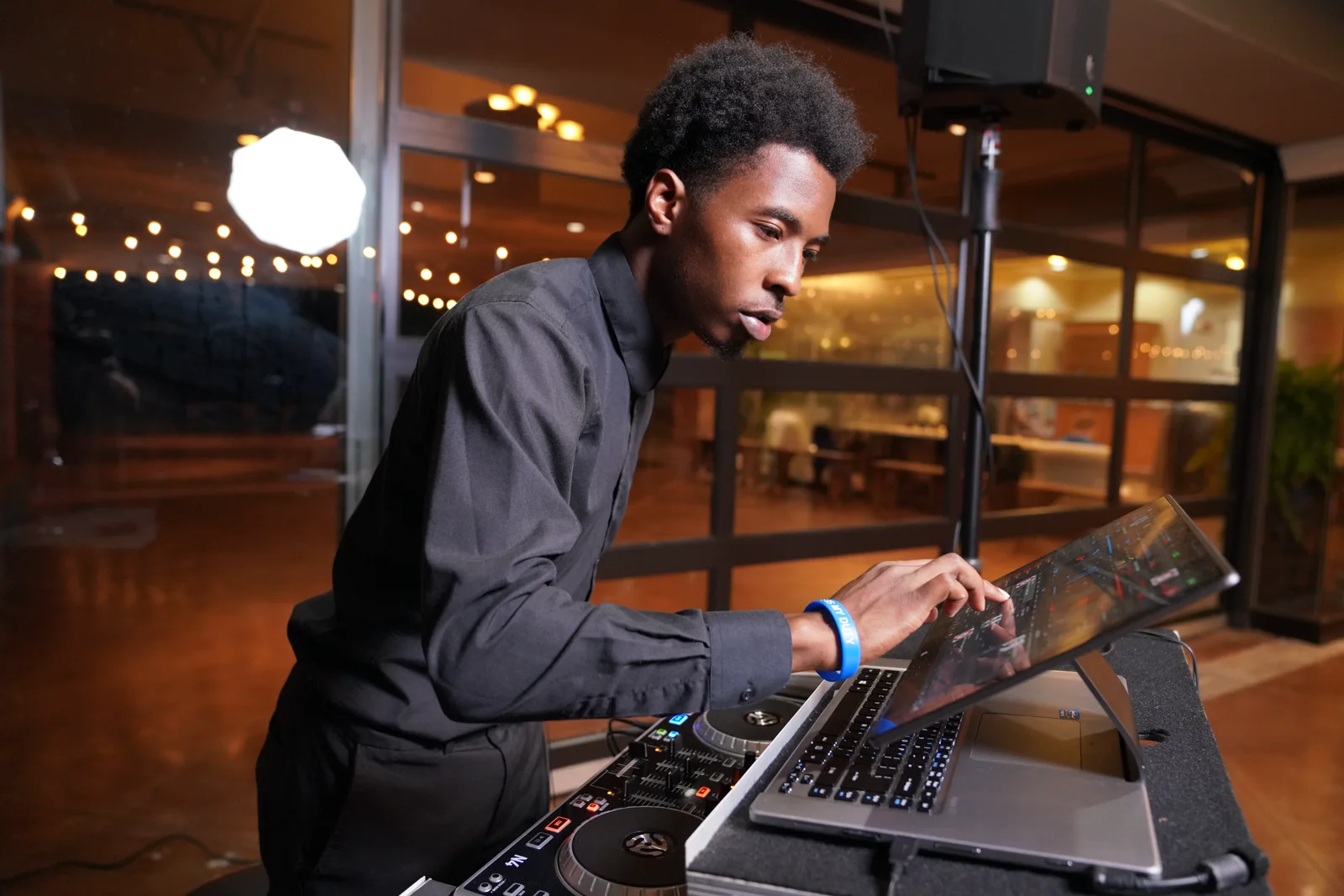
Corporate Event DJ Cost in Detroit (2026)
If you’re the person who got handed the company party, you probably want one number, fast. So here it is: corporate event DJ cost in Detroit runs about $800 to $2,400 for most business events in 2026, with the majority of bookings landing between $1,100 and $1,700. That range moves based on hours, room size, sound coverage, and whether you need microphones for a program. Below, I’ll break down exactly what pushes a quote up or down, so you can build a budget line that survives your finance team’s questions.
In this article
Package ranges by event type
Not every company event needs the same setup, and the price follows the job. Here’s how it usually shakes out around metro Detroit.
Small office party or happy hour (up to 75 people, 3 hours): $800 to $1,100. One speaker pair, background music, a mic for a quick toast. Simple and clean.
Holiday party (75–200 people, 4–5 hours): $1,100 to $1,700. This is the most common booking I take. Full sound for a ballroom, a wireless mic for awards or remarks, dinner music, and a real dance set at the end.
Awards banquet or gala (150–400 people, 5 hours): $1,600 to $2,400. Bigger rooms need more coverage, plus a second mic, walk-up music for honorees, and tight coordination with a program that runs on a clock.
Conference or trade-show activation (multi-day or multi-room): quoted per day, usually $900 to $1,500 daily. Setup complexity matters more than crowd size here.
Those are honest working ranges, not sticker prices designed to hook you. If a quote lands far outside them in either direction, ask why — there’s always a reason, and it’s worth hearing.
What actually drives the price
Five things move a corporate quote, and none of them are mysterious.
Hours. The single biggest factor. Most quotes assume four hours of performance. Each extra hour typically adds $150 to $300. Load-in and teardown aren’t usually billed as performance time, but they’re real hours, which is why a two-hour event rarely costs half of a four-hour one.
Guest count and room shape. A long ballroom needs more speakers than a square one, even with the same headcount. Coverage is about geometry, not just volume.
Microphones and program support. If your night includes remarks, awards, or a video, that’s a whole extra layer: wireless mics, a backup mic, audio from a laptop, and cue coordination with whoever’s running the deck.
Lighting. Uplighting in brand colors is popular with companies and usually adds $300 to $700 depending on room size. It’s also the cheapest way to make a plain hotel ballroom look like it belongs to your brand.
Date and venue. December is the crunch. A Friday or Saturday in early December books out months ahead, and prices reflect that. A Thursday in February is a different conversation entirely.
What should be included at every level
Regardless of budget, a professional quote should already cover these. If any are missing, that’s not a bargain — that’s an incomplete quote.
Setup and teardown. A backup speaker and backup mic on site. At least one planning call before the event. Insurance (most Detroit venues require a certificate, and you’d be surprised how often that stops a booking cold). Formal attire appropriate to your event. And a written timeline confirming who speaks when.
That last one matters more than people expect. Corporate events live or die on the program. Weddings can drift 15 minutes and nobody blinks. A company event with a CEO speaking at 7:15 cannot drift, because half the room is watching the clock and the other half has a babysitter at home.
You can see how I structure that coordination on my corporate and events service page — the sound plan, the mic handoffs, and the program cues are all worked out ahead of time.
Nobody in that room will remember which song played at 8:40. Every single person will remember whether they could hear the CEO.
Hidden costs to ask about upfront
Here’s what a lot of planners miss, and it’s usually where a budget blows up two weeks before the event.
Overtime. Ask the hourly rate for going long, in writing, before you sign. Company parties run over constantly. Knowing the number in advance turns a stressful decision into a shrug.
Travel and parking. Downtown Detroit venues often mean paid parking and long load-ins. Some vendors bill that, some don’t. Ask.
Early setup. If your venue only allows load-in at 2 p.m. for a 7 p.m. start, that’s five hours of standby. Reasonable vendors handle it, but it should be discussed, not discovered.
Power and venue requirements. Older buildings sometimes need specific circuits. A quick call between your DJ and the venue’s event manager prevents a very bad surprise at 5 p.m.
Extra rooms. Cocktails in the atrium and dinner in the ballroom means two sound zones, which means more gear. Mention every space you’re using when you request a quote.
Key takeaway: Budget $1,100 to $1,700 for a typical Detroit company holiday party with 75 to 200 guests. Confirm hours, mic count, number of rooms, and the overtime rate before signing — those four items explain nearly every quote difference you’ll see.
Why the cheapest quote usually costs more
I want to be fair here: a low quote isn’t automatically bad. Some newer DJs price low because they’re building a portfolio, and plenty of them are terrific.
But there’s a version of cheap that costs real money. It looks like this: no backup gear, so a failed speaker ends the program. No insurance, so the venue denies entry at load-in. No planning call, so the awards run 40 minutes late and dinner gets cold. None of those show up on the invoice, and all of them show up in your inbox on Monday.
Corporate events also carry a reputational cost that weddings don’t. If the audio fails during your VP’s remarks, 200 employees watched it happen. That’s the thing to weigh — not the $300 difference between two quotes. Event industry guidance from Eventbrite’s organizer resources makes the same point about A/V: it’s the line item where cutting corners is most visible.
One quick way to test a quote: ask what happens if a speaker fails at 7:30. A pro will describe the backup, where it lives, and how long the swap takes. Someone winging it will say “that’s never happened.” Both answers tell you everything you need to know about what you’re buying.
My honest advice: get three quotes, throw out the highest and lowest, and interview the middle one. That’s usually where the good work lives.
How to build the budget line
If you need to present a number, build it in four parts and it’ll hold up to scrutiny.
Base package: your event type and hours from the ranges above. Add-ons: uplighting, extra mics, second room. Contingency: add 15% for overtime and last-minute changes, because there are always last-minute changes. Tip or service consideration: optional, but 10–15% is common for corporate work and worth flagging so it isn’t a surprise.
For a 150-person holiday party at a downtown hotel, that math typically looks like $1,450 base, $450 uplighting, $285 contingency, for a planning number right around $2,200. Bring that to finance instead of a single number, and you’ll almost never have to go back for more.
Also consider who’s paying and when. Many companies need an invoice, a W-9, and a purchase order before a deposit can go out, and that paperwork takes longer than the booking itself. Start it the same week you choose a vendor, or you’ll be chasing accounting while the date slips away.
One more tip: ask for the quote to break out each line separately. It makes it easy to cut one item if you get squeezed, instead of renegotiating the whole thing.
Booking timeline for Detroit venues
Timing affects cost more than most planners realize, so here’s the practical schedule.
Holiday parties: book by August. Seriously. The first two weekends of December sell out first, and by October you’re choosing from whoever’s left. Booking early also locks the rate before peak-season pricing.
Spring and summer events: two to three months out is comfortable. Weekday events are easier and often cheaper.
Galas and awards nights: four to six months, mainly because the program coordination takes several conversations, not because the date is scarce.
Venue choice matters too. Downtown rooms near the riverfront and the theater district tend to have stricter load-in windows than suburban spaces in Troy or Southfield, and that shows up in scheduling. The Visit Detroit venue directory is a solid starting point if you’re still shopping spaces.
That’s the whole picture. Know your hours, your rooms, and your program, and a good vendor can quote you accurately in one phone call. If you want a real number for your event, take a look at more event planning guides, see how a full night runs in the Detroit event guide, or get to know Tevin first. I’ll give you a straight quote and tell you honestly if your budget needs adjusting — before you’ve promised anything to your boss.