Jazz Standards for a Timeless Reception
Picture the room you want. Low light, a champagne tower, everybody a little dressed up, and a brushed snare ticking along under the conversation. That’s what jazz wedding songs do for a reception — they make an ordinary ballroom feel like a supper club in 1958. Whether you’re going full black-tie or just want a vintage warmth under the night, jazz standards are the most flattering soundtrack a wedding can have. Here’s how to pick them, where to place them, and how to keep a jazz-leaning night from stalling out when it’s time to dance.
In this article
Why jazz makes a room feel expensive
Jazz does something no other genre does at a wedding: it sets a mood without demanding attention. The chords are rich, the tempos are relaxed, and nobody has to shout over a chorus. Your guests can actually hear each other say congratulations.
That’s the secret to why jazz wedding songs read as “expensive” even when your budget is normal-sized. Jazz signals care. It says somebody thought about this room. A pop playlist on shuffle says the opposite, no matter how good the songs are on their own.
Here’s the other thing. Jazz standards have been recorded fifty different ways by fifty different singers, which means you can dial the exact feel you want. Want breezy? Go Ella Fitzgerald. Want smoky? Chet Baker. Want big and confident? Sinatra with the Count Basie band. Same song, wildly different room.
There’s a generational bonus too. Jazz standards were written between roughly 1920 and 1960, which means your grandparents grew up on them and your friends know them from movies, video games, and coffee-shop speakers. Almost nobody dislikes jazz. That’s rarer than it sounds — every other genre has a group of guests quietly hoping it ends. This one doesn’t.
Cocktail hour: the easy standards
Cocktail hour is jazz’s home turf. People are standing, drinks are moving, and you need music that fills the space without stepping on it.
My reliable cocktail set: “Fly Me to the Moon” (Sinatra), “The Way You Look Tonight” (Sinatra or Tony Bennett), “Cheek to Cheek” (Ella and Louis), “Dream a Little Dream of Me” (The Mamas & the Papas version works too), “Beyond the Sea” by Bobby Darin, and “L-O-V-E” by Nat King Cole. Six songs and the whole room already feels like a movie.
For something a little cooler and less obvious, try instrumental Vince Guaraldi, early Dave Brubeck, or the Bill Evans Trio. “Take Five” during a cocktail hour is one of my favorite quiet flexes — it’s odd-metered and jazzy but so familiar that nobody finds it strange.
One volume note. Cocktail jazz should sit right under conversation, never on top of it. If two people three feet apart have to lean in, it’s too loud. I set that level in the actual room on the day, not from a number on a mixer.
Dinner: crooners and quiet swing
Dinner is where a lot of couples default to soft acoustic covers, which is fine, but jazz does the job better. It’s warmer, it’s got more color, and it doesn’t sound like a coffee shop.
Lean into the crooners here. Nat King Cole, Dean Martin, early Frank Sinatra, Ella Fitzgerald, Sarah Vaughan, Etta James, and Nina Simone. If you want modern voices in the same lane, Michael Bublé, Diana Krall, Norah Jones, Gregory Porter, and Laufey all fit right in without breaking the spell.
Skip the smooth-jazz saxophone stuff, though. That’s the one corner of the genre that reads as elevator music, and it’ll flatten your room faster than silence would. Stick to real standards, real vocalists, and real trios.
A pattern that works well: start dinner with instrumentals while plates come out, then bring in vocals as people settle. Around the last course, nudge the tempo up a notch with something like “It Don’t Mean a Thing (If It Ain’t Got That Swing).” That’s your signal, musically speaking, that the party half of the night is about to start. Nobody consciously notices, but everybody feels it.
Jazz doesn’t ask for the room’s attention — it earns it quietly. That’s why a jazz-set dinner feels like an occasion instead of a meal with background noise.
Jazz first dance songs
Jazz first dances are gorgeous, and they solve a problem most couples don’t see coming: dancing to a slow pop ballad is genuinely hard. There’s no clear pulse to hold onto. A jazz standard has a walking bass line that basically tells your feet what to do.
Top picks I get asked for: “The Way You Look Tonight,” “At Last” (jazz-adjacent, and it never fails), “L-O-V-E,” “Come Away With Me” by Norah Jones, “Unforgettable,” “The Very Thought of You,” and “It Had to Be You” by Harry Connick Jr. If you want something a little unusual, “Moon River” or Etta James’ “A Sunday Kind of Love” are both stunning.
Pick the recording carefully. Sinatra’s 1964 “The Way You Look Tonight” is a completely different mood than the 1936 Fred Astaire original. One is bold, one is delicate. Send me the exact version you love, not just the title — that one email has saved more first dances than any piece of gear I own. The whole first-dance and formalities flow is mapped out on my wedding entertainment page if you want to see how the pieces line up.
Key takeaway: Use jazz as your foundation, not your entire night. Standards through cocktail hour, dinner, and the formal dances give you the vintage feel — then swing and soul carry the floor after that, so the energy climbs instead of flattening.
Swing that actually fills a floor
Now, real talk. A lot of jazz is not dance-floor music, and pretending otherwise is how a black-tie wedding ends up with an empty floor at nine o’clock. But some of it absolutely rips, and those are the songs you want.
The swing floor-fillers: “Sing, Sing, Sing” by Benny Goodman, “Jump, Jive an’ Wail” by Louis Prima or Brian Setzer, “Mack the Knife” by Bobby Darin, “That’s Life” by Sinatra, “Zoot Suit Riot” by Cherry Poppin’ Daddies, and “Minnie the Moocher” by Cab Calloway. That last one is a hidden gem — the call-and-response gets even shy guests shouting “hi-de-hi-de-ho.”
Here’s what a lot of couples miss. A swing block works best when it’s short and early. Three or four songs right when open dancing starts, while people still have energy and drinks in hand. Try to run swing for a full hour and you’ll watch the floor thin out song by song, because most guests only know how to dance to about four of these. Hit it hard, then move on while everyone’s still smiling.
Michigan has real history here, too. Detroit’s jazz scene is nationally serious — the Detroit Jazz Festival is one of the largest free jazz festivals anywhere, and plenty of guests at a metro-Detroit wedding have been to it. That familiarity helps. When you play a standard around here, people don’t hear “old.” They hear “ours.”
Blending jazz with modern music
You do not have to choose between a vintage wedding and a packed dance floor. You just have to plan the handoff.
My favorite bridge is Motown. It shares jazz’s warmth and horn sections, so going from “Mack the Knife” into “Signed, Sealed, Delivered” feels natural instead of jarring. From Motown you can climb into disco, then ’90s R&B, then whatever your crowd actually wants at eleven p.m. Nobody notices the ladder — they just notice they never sat down.
Another trick: jazz-flavored modern songs. Amy Winehouse’s “Valerie,” Bruno Mars’ “Just the Way You Are,” Postmodern Jukebox covers of current hits, and Michael Bublé’s “Feeling Good” all keep the vintage costume on while sneaking in familiar hooks. Guests in their twenties respond to these instantly. Planners at WeddingWire’s reception song guide point out the same thing — the crossover songs are what keep a themed playlist from feeling like a costume party.
Pulling it off in Plymouth
Plymouth is honestly a great fit for a jazz-forward wedding. Downtown around Kellogg Park has that old-town, string-lights, brick-storefront look, and the venues nearby tend to be warmer and more intimate than the big highway ballrooms. Jazz belongs in rooms like that.
Guest count matters here too. A jazz-forward night shines at 80 to 150 people, where the room stays conversational and the music can breathe. At 300 guests in a cavernous hall, you’ll want to lean harder on the swing and Motown blocks so the energy doesn’t get lost in all that air. Same songs, different ratio.
Two things make the biggest difference in a smaller room. First, lighting: amber and soft-white uplighting reads instantly vintage, while cool blue kills the whole mood. Second, speaker placement. In a low-ceilinged room, I run smaller, wider-spread sound so the music sits evenly instead of blasting the front tables. Jazz has a lot of quiet detail in it, and detail is the first thing bad sound throws away.
If you’re building your list right now, keep it simple: give me eight to ten songs that genuinely matter to you, tell me the mood words you want (vintage, warm, black-tie, cool), and let me fill the gaps live. You’ll find plenty more genre breakdowns in the rest of my music guides, and my Plymouth wedding guide covers venues and timing for this area specifically.
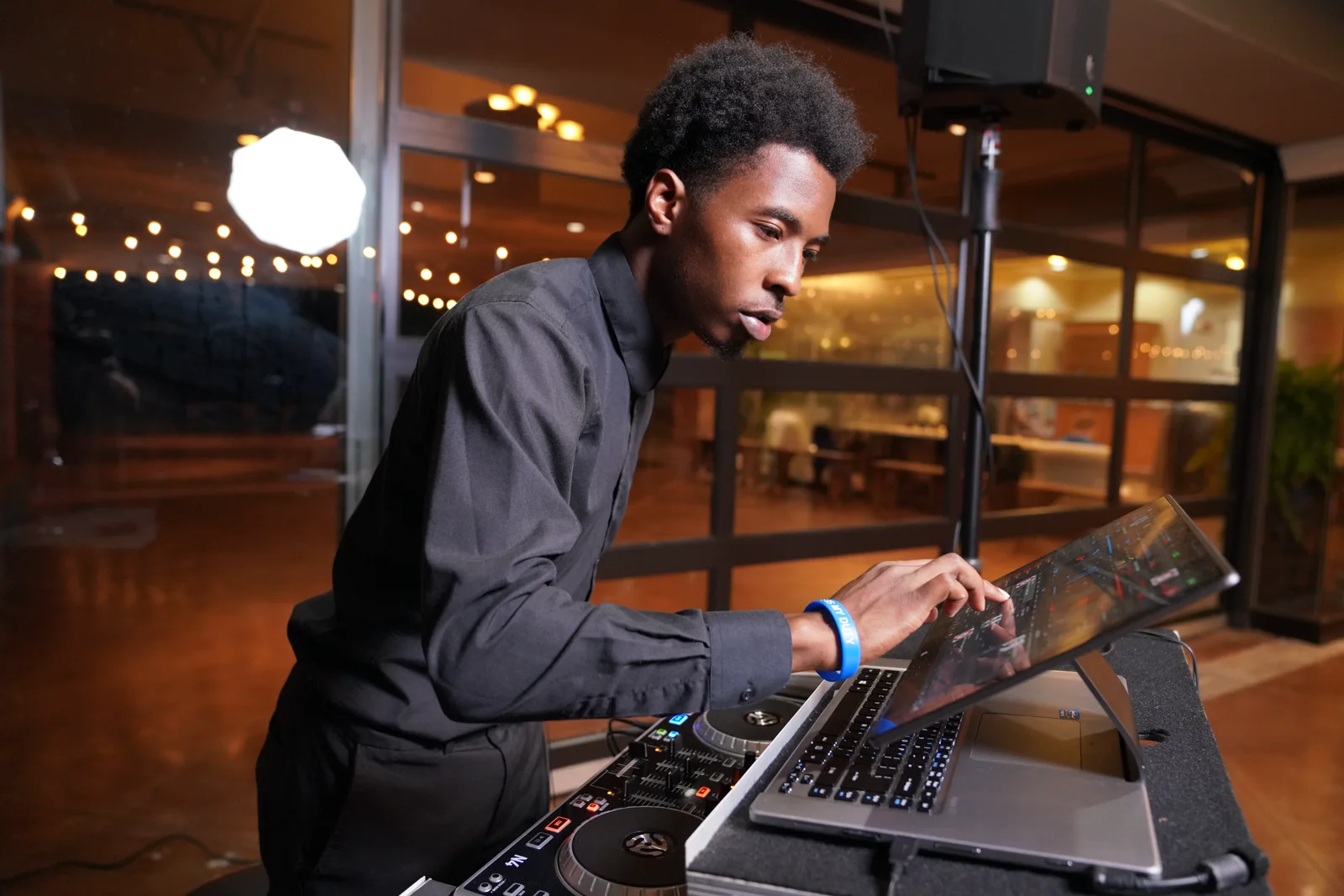
A jazz wedding isn’t about being fancy. It’s about a room where people can hear each other, laugh a little louder, and then get swept onto the floor when the horns kick in. If that’s the night you’re picturing, say hello and meet your DJ — I’d love to help build it.