
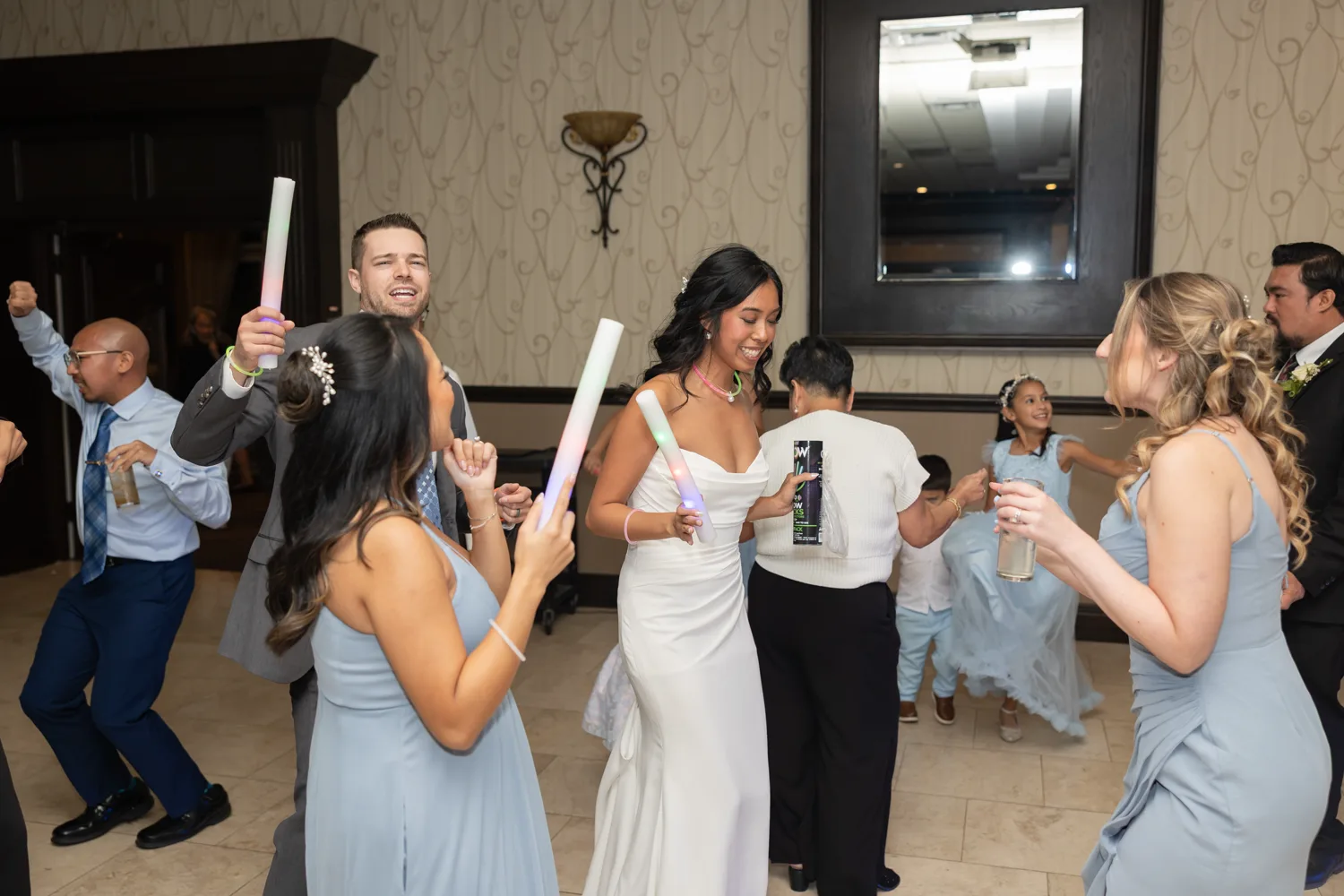
Line Dances That Get Everyone Up
Some songs ask people to dance. Wedding line dances tell them how. That’s the whole reason they still work in 2026, long after everyone swore they were played out. When the steps are built into the song, nobody has to be a good dancer — they just have to follow the person in front of them. Below is the full roundup: the classics that never miss, the newer additions worth adding, how many to schedule, and exactly when to drop them so your floor fills instead of thins.
In this article
Why line dances still fill a floor
Think about the last wedding you went to. There was probably a moment when a song came on and 60 people appeared out of nowhere. That’s not an accident. It happens because the song removes the one thing that keeps guests seated: not knowing what to do with their body.
A regular dance song asks you to invent something. A line dance hands you instructions. Left, right, slide, clap. Even a guest who hasn’t danced since 1994 can follow that, and once they’re standing, they usually stay standing for the next three songs too.
There’s a social piece as well. Nobody does a line dance alone, so there’s no spotlight and no risk. You’re one face in a grid of 50. That safety in numbers is why wedding line dances pull in the shy uncle, the teenagers, and the bridal party all at once.
They also buy you time in a way nothing else does. A four-minute line dance holds the floor for four solid minutes with zero risk of drift, which gives me a window to set up the next block, cue a special song, or check in with your coordinator. Guests never see the work. They just feel a night that never stalls.
Are some of them corny? Sure. That’s the point. Corny is disarming. I’ve watched a room of buttoned-up professionals turn into a giggling mess 30 seconds into a song they claimed to hate, and every one of them was still out there when the next track started.
The classic wedding line dances
These are the reliable ones. If I could only carry five line dances into a reception, this would be the list.
“Cha Cha Slide” — DJ Casper. The king. The song literally calls out every move, so there’s zero learning curve. It works for ages 6 to 86, and it’s my go-to when the floor needs a jolt.
“Cupid Shuffle” — Cupid. Four steps, one turn, repeat. Even easier than the Cha Cha Slide, and the tempo is friendlier for older guests. This one is my favorite opener of the two.
“The Wobble” — V.I.C. A little more attitude, a little more room to freestyle. Younger crowds love it. Play it after the floor is already warm and it goes off.
“The Electric Slide” (Electric Boogie) — Marcia Griffiths. The one your parents know by heart. It bridges generations better than almost anything else on the list.
“Y.M.C.A.” — Village People. Technically not a line dance, but it does the same job: everybody knows the moves, and everybody does them.
Newer line dances worth adding
The classics carry the night, but a couple of fresh ones keep your younger guests from feeling like they walked into 2007. Here’s what’s actually landing right now.
“Boots on the Ground” — 803Fresh. The soul line dance that took over 2025. Smooth, easy to follow, and huge with the 40-plus crowd who came up on steppin’.
“Candy” — Cameo. Not new at all, but the line dance built on it is a staple at Detroit-area receptions and a lot of guests already know it cold.
“Before I Let Go” — Frankie Beverly & Maze. The unofficial anthem of every family cookout in America. The Beyoncé version works too, though the original usually gets the bigger reaction from the aunties.
“Level Up” — Ciara. The challenge choreography made this one a floor-filler for guests in their twenties and thirties. Not everyone knows it, but the ones who do will teach the rest.
One caution: newer dances have a shorter reach. If only 15 people know the steps, the song can stall. Pair a new one right after a classic so the floor is already loaded when it starts. Song lists from The Knot’s reception song guide are a decent temperature check on what’s trending nationally, though Michigan crowds have their own favorites.
A line dance isn’t really about the dance. It’s permission — a song that tells 60 people at once that it’s safe to stand up.
Cultural and regional favorites
Here’s where your family’s background changes the list, and it should. Some of my favorite reception moments come from dances that only half the room knows — because the other half learns them on the spot.
Greek and Middle Eastern weddings bring the circle dances: kalamatianós, dabke, and hora. These aren’t line dances in the American sense, but they do the same thing. Everyone links up, and nobody’s dancing solo.
Jewish receptions have the hora, and it’s the single most joyful five minutes at any wedding I play. Polish families around metro Detroit still call for the polka set. Latin crowds want a merengue or bachata block that functions the same way.
And then there’s Detroit itself. Ballroom steppin’ and the Detroit two-step are alive and well here, and if your guest list has Detroit roots, leaving them off is a missed opportunity. I always ask couples about family traditions during planning — that one question has saved a lot of dance floors. A good reception DJ and MC should be asking it too.
Key takeaway: Three to four line dances is the sweet spot for most receptions. Space them roughly 30–40 minutes apart, lead with the easiest one, and always park a familiar floor-filler right behind each one so the crowd doesn’t scatter.
How many should you play?
Here’s what a lot of couples miss: line dances are seasoning, not the meal. Play too many and the reception starts to feel like a gym class. Play none and you lose the easiest floor-filling tool there is.
My number is three to four across a four-hour reception. That’s usually one early to break the ice, one mid-night when energy dips after cake, and one or two in the back half when the crowd is loose. Anything past five and guests start to notice the pattern.
Spacing matters as much as the count. Give them 30 to 40 minutes of breathing room between each one. Back-to-back line dances tire people out fast, because you’re asking the same muscles to do the same thing twice.
One more rule that saves nights: never end a block on a line dance. The song finishes, the rows break up, and half the floor walks off. So I always follow one with a big familiar hit — a Motown record or a current pop smash — to hold the crowd right where they are.
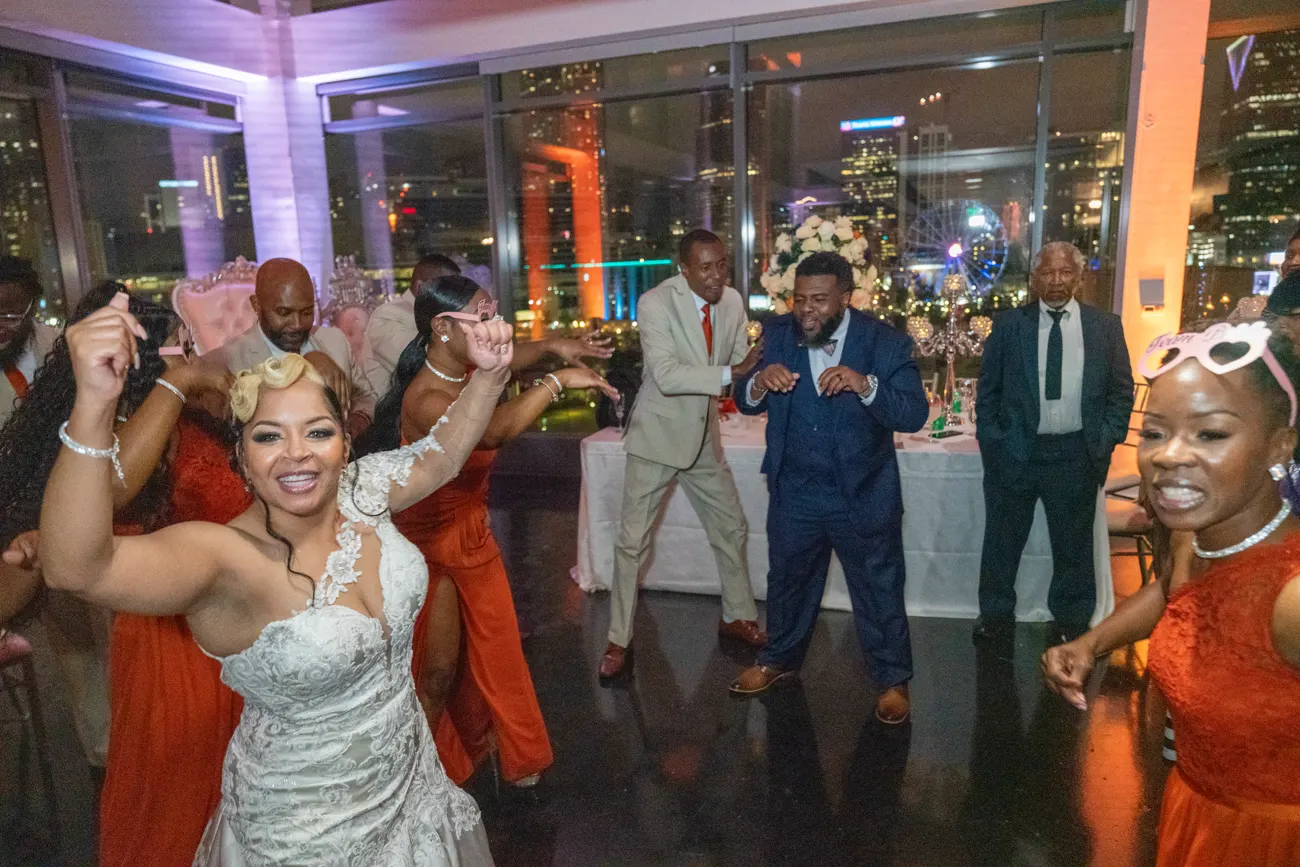
Where they fit in the timeline
Timing is the difference between a packed floor and a polite one. Line dances are best used as a repair tool and an accelerant, not as filler.
The first window opens right after the formal dances end and open dancing starts. The room is unsure, everyone’s watching everyone else, and one Cupid Shuffle solves it in 90 seconds. That’s your icebreaker.
The second window comes after cake cutting or a toast, when the room has just been sitting and the energy flatlined. Line dances rebuild momentum faster than any single pop song will. Reception timelines like the ones at Zola’s expert advice hub show exactly where those energy dips tend to land.
The last window is the final hour, when guests are past caring how they look. Save one crowd-pleaser for there. It’s also a good spot for a newer dance, since the people still standing are the ones most likely to know it.
What I don’t recommend is scheduling them to the minute. I keep three loaded and ready, then use them when the room asks for one. Reading that moment live is the job.
Building your list in Northville
Ready to build yours? Start by picking two classics you genuinely like, then add one cultural or family dance, then leave the fourth slot open for your DJ to fill live. That structure gives you control without locking the night down.
Write a do-not-play line too. If the Chicken Dance makes you cringe, say so in writing — it’s a lot easier than stopping it mid-song. Most couples have exactly one they can’t stand, and it’s usually that one.
Northville weddings tend to draw guests from all over southeast Michigan, and the historic downtown venues near Main Street often have compact floors. On a smaller floor, line dances actually work better: 40 people in rows looks and feels packed. I plan the block sizes around the room, not just the guest count.
If you want more song ideas by category, browse more reception music guides anytime, and my Northville wedding guide walks through the full night from ceremony to last call. Want a list built around your actual family? You can meet your DJ and we’ll put it together over one easy call. Your guests already know how to dance — they just need the right song to say so.