
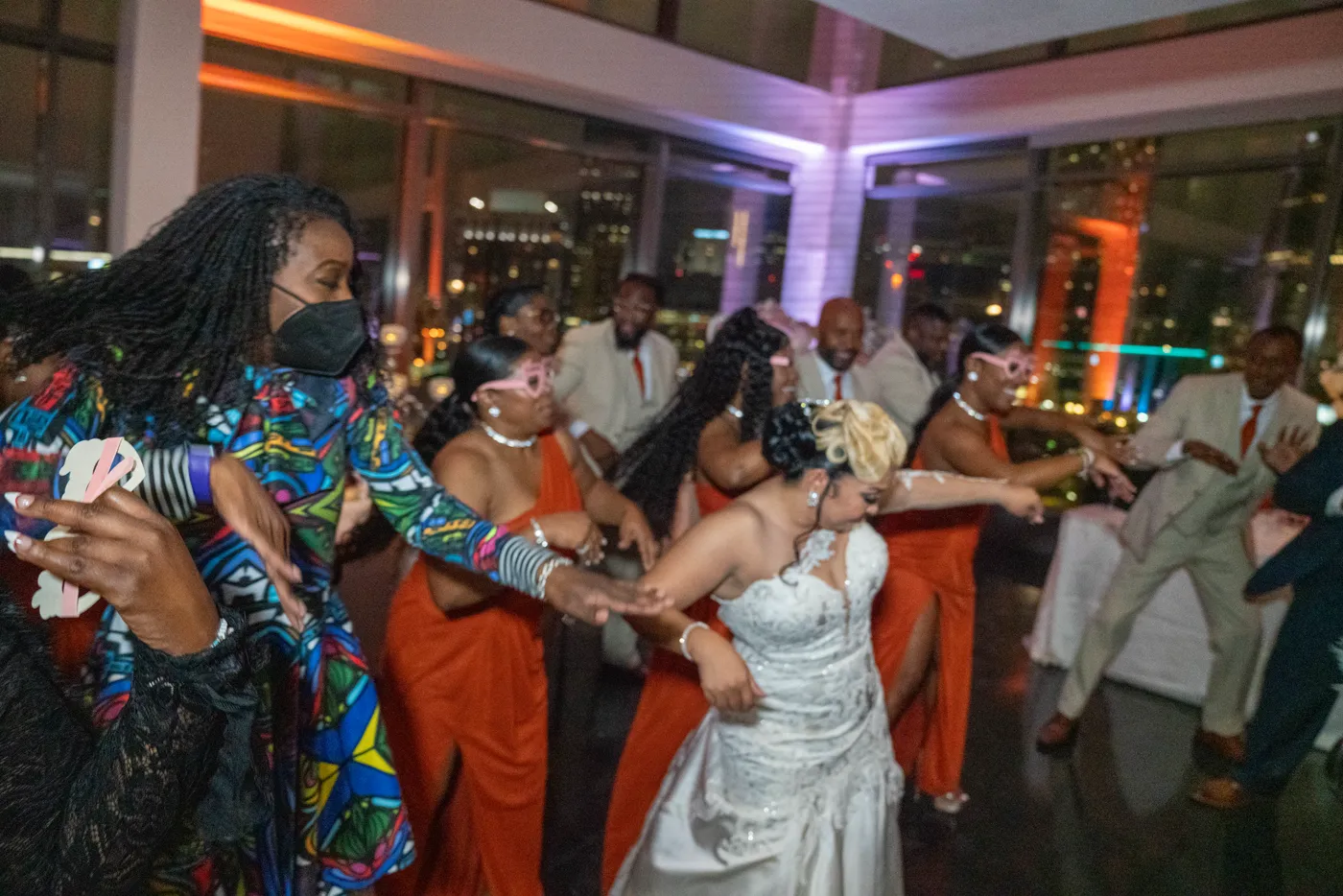
Hora Songs for the Jewish Wedding Chair Dance
There is no moment at a wedding quite like the hora. One minute people are politely finishing salad; the next, 90 guests are in a spinning circle and somebody’s 78-year-old great-uncle is helping hoist a chair into the air. Great hora songs are what make that happen — not one song, but a set that starts warm, climbs, and peaks right when the chairs go up. Here’s how to build it, how long it should run, and how to make sure nobody ends up on the floor.
In this article
What the hora is and when it happens
The hora is a circle dance, and at a Jewish wedding it’s the celebration in its purest form. Guests link arms, move in a ring, and the tempo builds until the room is one big joyful mess. Somewhere in the middle, the couple gets lifted on chairs, holding opposite ends of a napkin between them.
Most couples place it right after the grand entrance. That’s my favorite spot, because everyone’s already standing and the energy has nowhere to go but up. Some families run it after the first course instead, which also works — the key is doing it before people get comfortable in their chairs.
Length matters more than people expect. A good hora runs 12 to 20 minutes. Under eight minutes feels rushed and cheats your grandparents out of their favorite part. Past 25, arms get tired and the circle starts to thin out.
Hava Nagila and the classics
Let’s start with the songs almost everyone knows. These are the backbone of nearly every hora set I play.
“Hava Nagila.” The most famous of all hora songs, and the one guests of every background can clap along to. Its natural accelerando — slow start, faster and faster finish — is exactly why it works.
“Siman Tov u’Mazal Tov.” Short, chant-like, and easy for a whole room to sing. Perfect early in the set while the circle is still forming.
“Od Yishama.” A wedding blessing set to music. Warm, celebratory, and it sits nicely in the middle of a set.
“Sisu V’Simchu.” Bright and bouncy. Good for keeping momentum between the bigger moments.
“David Melech Yisrael.” Simple, repetitive, and beloved by kids at the wedding — who are usually the first ones in the circle anyway.
“Am Yisrael Chai.” Strong and anthemic. Many families want this one specifically, so ask before you assume.
Building a set that keeps climbing
Here’s the part couples rarely think about: a hora isn’t a playlist, it’s a curve. The tempo should rise steadily so the room feels like it’s being pulled along.
I usually open around 120 beats per minute, which is fast enough to feel exciting but slow enough that grandparents can join the ring. Over the next several minutes, I move up in steps — never a jarring jump, just a steady climb. By the time the chairs come out, we’re near the top.
Transitions matter too. Hard stops between songs let the circle break apart. I mix hora tracks together so the dance never actually pauses, which is the same approach I use for any continuous dance block on the weddings I play. One unbroken 15-minute run beats six separate songs every time.
One more piece: leave room to extend. If the energy is enormous and nobody wants to stop, I want three more tracks ready. If Aunt Sharon looks like she needs a chair, I want a clean exit ramp. Flexibility is the whole point of a live DJ.
A hora isn’t a song. It’s a fifteen-minute climb — and the chairs should go up at the very top of it, never at the start.
The chair dance, done safely
Now the part that makes photographers nervous. The chair lift is spectacular, and it’s also the only moment of the night with actual physics involved.
Start with the chairs themselves. Use sturdy banquet chairs with no wheels and no arms. Arms make it hard to grip and hard to get down. Wheels are an obvious no.
Then pick your lifters — four per chair minimum, six if the guests are on the smaller side. Choose people who are steady on their feet and, ideally, who have not spent the cocktail hour proving something at the bar. Have them lift on a count, together, and keep the chairs low enough that the couple can still see each other.
Ceiling height is a real factor too. Chandeliers, low beams, and string lights have ended more than one chair lift early. Walk the room with your DJ and your venue coordinator beforehand and pick the exact spot for the lift.
Finally, the napkin. The couple each holds one end while they’re up, which keeps them connected and gives them something to hold onto. It also produces the photo that ends up framed in the hallway for the next 40 years.
Key takeaway: Plan a 12 to 20 minute hora that climbs in tempo, mix the songs together so the circle never breaks, and lift the chairs at the peak — four to six steady lifters each, no wheels, no arms, and a clear spot away from the chandelier.
Modern Israeli tracks and klezmer
Here’s what a lot of couples miss: the hora doesn’t have to be only the standards. Plenty of families want something that sounds like right now, and there’s a deep catalog to pull from.
Modern Israeli pop works beautifully in the second half of the set, once the circle is established and the tempo is already high. Upbeat Hebrew tracks with a driving beat land well with younger guests and keep the older ones going, because the rhythm is familiar even when the song isn’t.
Klezmer is the other direction, and it’s wonderful. A fast freylekhs — clarinet leading, everything else chasing — has an unhinged joy that recorded pop can’t match. Some families hire a live klezmer trio for the hora specifically and hand the rest of the night to the DJ. When that’s coordinated well, it’s one of my favorite setups.
If you’re blending traditions, the background at My Jewish Learning’s guide to Jewish weddings is a solid primer for family members who aren’t sure what to expect. Send it around before the wedding and the whole circle moves better.
Mezinke and other family moments
The hora often isn’t the only family dance of the night. A few others are worth planning for.
The mezinke honors parents who are marrying off their youngest child. The parents sit in the center, guests circle them, and the couple crowns them with flowers. It’s tender and funny at the same time, and it needs its own song — usually a traditional mezinke tune. Ask your parents whether they want it, because some families feel strongly and some have never heard of it.
There’s also the krenzl, a similar honor for a mother marrying off her last daughter. And at more traditional weddings, the mitzvah tantz comes late in the evening with its own rules and music.
None of these should be a surprise on the day. Ten minutes on the phone sorts all of it out. Broader tradition explainers like The Knot’s Jewish wedding traditions guide can help you decide what you want to include before that call.
Planning it in Farmington Hills
Farmington Hills sits at the center of one of the largest Jewish communities in Michigan, and I’ve played plenty of celebrations here where the hora was the loudest 15 minutes of the year. Whether you’re at a synagogue social hall off Middlebelt, a banquet space near Twelve Mile, or a country club just over the line in West Bloomfield, a few local realities are worth knowing.
Check the ceiling. Some of the prettiest rooms in the area have low chandeliers right over the center of the floor, which is exactly where the circle wants to go. Pick your lift spot in advance and I’ll steer the crowd there with one line on the mic.
Check the floor size, too. A hora needs more room than a normal dance block because the circle expands outward as more people join. If the dance floor is tight, ask the venue about pulling two tables or widening the parquet. It makes a bigger difference than any lighting choice.
Last thing: tell your DJ which songs your family needs. Every family has them, and no generic list will guess correctly. Give me those, and I’ll build the climb around them. For the full picture of how a Michigan reception flows from entrance to last call, my Detroit wedding guide lays it out, and there are more tradition guides in the archive. Want to talk it through first? You can always meet your DJ before you book.