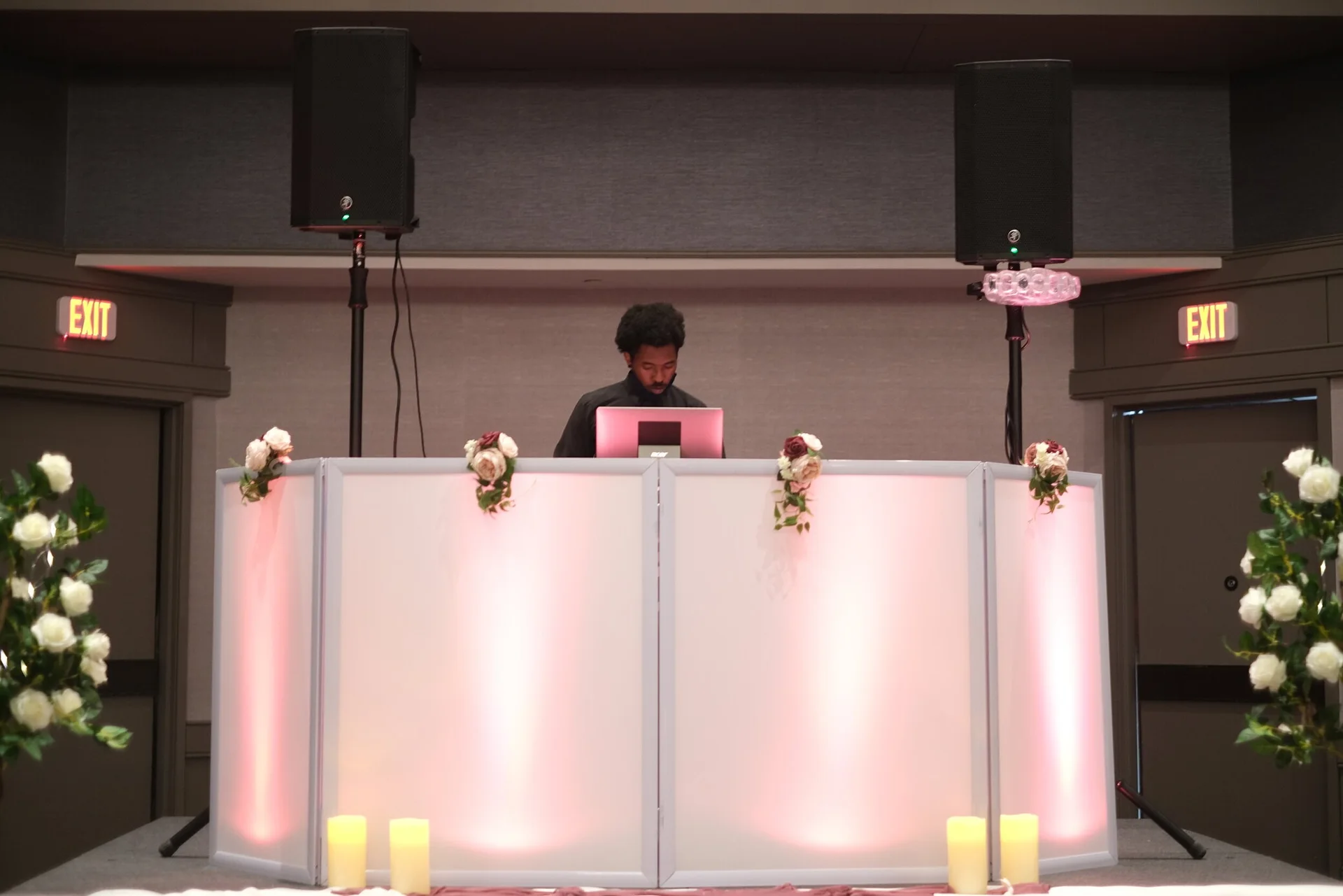

What’s Behind a Clean DJ Booth Setup
Look at a great DJ booth setup and you’ll see something simple and clean — a neat facade, a soft glow, maybe a monogram out front. What you won’t see is the tangle of cables, power strips, and backup gear tucked behind it. That’s on purpose. The whole point of a polished booth is to hide the work so your photos look crisp and the room feels calm. Here’s what actually lives behind that clean front, why it matters for your Novi wedding, and how to tell a pro rig from a mess of wires.
In this article
The facade, and why it exists
Let’s start with that clean front. A DJ facade is the panel guests actually see — often white, sometimes lit, sometimes wearing your initials. It’s the polished face of the whole operation, and it’s there for one reason: to make the booth part of your decor instead of a pile of equipment.
Think of it like a stage set. The audience sees a beautiful scene; behind the curtain, it’s ropes and pulleys. A DJ booth setup works the same way. The front is designed to look effortless, which is exactly why the messy reality stays out of sight.
That choice does real work for your room. A tidy booth reads as intentional and calm. A rat’s nest of visible cables reads as chaos, even if the DJ is great. Presentation is part of the job, not an afterthought.
What’s really hiding back there
So what’s behind the facade? More than most couples expect. There’s the mixer and player up top, of course. But below and behind sit the power distribution, the wireless receivers for the mics, and a laptop with a backup ready to take over.
There’s also redundancy — the stuff nobody sees unless something goes wrong. A spare mic, extra cables, a backup drive with the whole music library copied over. I plan for the worst so your night never feels it. Good gear is only half of it; the other half is having a Plan B for everything.
All of that has to fit in a small footprint and stay reachable. When a request comes in or a cable gets bumped, I need to fix it in seconds without crawling around on the floor. So the layout back there is deliberate, not random. According to DJ TechTools, a smart, repeatable layout is what separates a reliable rig from a stressful one.
The best part is that I set it up the same way every single time. Same gear in the same spots, same cable runs, same labels. That routine means muscle memory takes over on your wedding day, so my head stays on reading the room instead of hunting for a plug. Consistency behind the scenes is what buys the calm you feel out front.
Cable management is the whole game
Here’s the unglamorous truth: cable management is where clean setups are won or lost. A pro rig might have twenty-plus cables running through it, and every one is bundled, labeled, and routed out of sight.
Why fuss over wires? Two reasons. First, it looks sharp — no black spaghetti creeping into your photos. Second, it’s fast to troubleshoot. When cables are neat and labeled, I can trace a problem in seconds instead of yanking on a mystery cord and killing the music mid-song.
Loose cables are also the number-one way to lose a room. One tripped-over power cable and the whole floor goes silent right in the middle of a peak moment. Tidy routing keeps that from ever happening. Want to see how I handle every part of the night, not just the gear? My wedding DJ walkthrough covers the full flow.
There’s a signal-quality angle here too. When power cables and audio cables are bundled neatly and kept apart where they should be, you avoid that faint hum or buzz that creeps into a system built in a hurry. So the same tidiness that looks good also sounds good. Neat isn’t just for show — it’s part of why a pro rig comes through clean from the first song to the last.
The best DJ booth is the one you never think about. When the setup disappears into the room, all that’s left is the music — and that’s the whole idea.
Clean setups are safer setups
Here’s what a lot of couples miss: a tidy booth isn’t just about looks. It’s about keeping your guests safe. Those hidden, taped-down cables are also trip hazards handled before anyone gets hurt.
Picture the dance floor at midnight. It’s dark, it’s crowded, and people aren’t watching their feet. A single loose cable across a walkway is an accident waiting to happen. So I tape down every run that crosses a path and route the rest completely out of reach.
Power safety matters too. Overloaded outlets and daisy-chained strips are how gear fails and, worse, how sparks start. A pro spreads the load across circuits and knows the venue’s limits. It’s boring, careful work — and it’s exactly what keeps your celebration smooth from start to finish.

Why your photos will thank you
Here’s a perk couples don’t think about until they see the album. Your booth ends up in the background of a lot of photos — the first dance, the toasts, the wide shots of the whole room. So how it looks really does matter.
A clean facade reads as elegant in those frames. A messy tangle of cords and road cases reads as clutter, and your photographer can’t always crop it out. Every corner of your room shows up somewhere, and a tidy booth keeps the focus on you instead of the equipment.
It gets even better when the facade is lit to match your colors. A soft glow that picks up your uplighting turns the booth from a necessary piece of gear into part of the decor. Little touches like that are why a polished setup is worth the extra setup time — they pay you back every time you flip through the pictures.
Key takeaway: A clean DJ booth setup is a facade with real work behind it — hidden cables, backup gear, and a smart layout. It keeps your guests safe, your photos sharp, and your room feeling calm. When the setup disappears, all that’s left is the music and the memories.
How to spot a pro rig
So how do you tell a real setup from a shaky one before you book? You don’t need to be a tech expert. A few simple tells give it away every time.
First, look at photos of the DJ’s actual booth. Is it clean and finished, or is there gear stacked on folding tables with cords everywhere? A DJ who’s proud of their rig will show it off. Second, ask about backups. If they can quickly explain what happens when a laptop or speaker fails, they’ve thought it through.
Also ask how early they arrive. A clean, safe setup takes real time — usually an hour or more — so anyone promising to roll in fifteen minutes before guests is cutting corners you’ll feel later. The care shows up long before the first song. Curious how I approach all of it? You can meet your DJ and see for yourself.
Placing the booth at your Novi venue
Where the booth goes matters as much as how it’s built. The ideal spot is close to power, near the dance floor, and out of the main sightlines for your ceremony and toasts. A quick walkthrough with your venue sorts this out fast.
Novi has some lovely rooms for a reception — from the big ballrooms near Twelve Mile Road to the hotels off Novi Road — and each one has its own power access and floor plan. A good DJ scopes the outlets and the layout ahead of time, so setup day has no surprises. For more planning help across the whole day, browse more wedding tips whenever you like.
At the end of it, the win is simple: a booth that looks like it belongs in your beautiful room, sounds incredible, and never once trips up your night or your guests. If you’d like help planning the layout for your day, my Novi wedding guide and I are happy to map it out with you.