
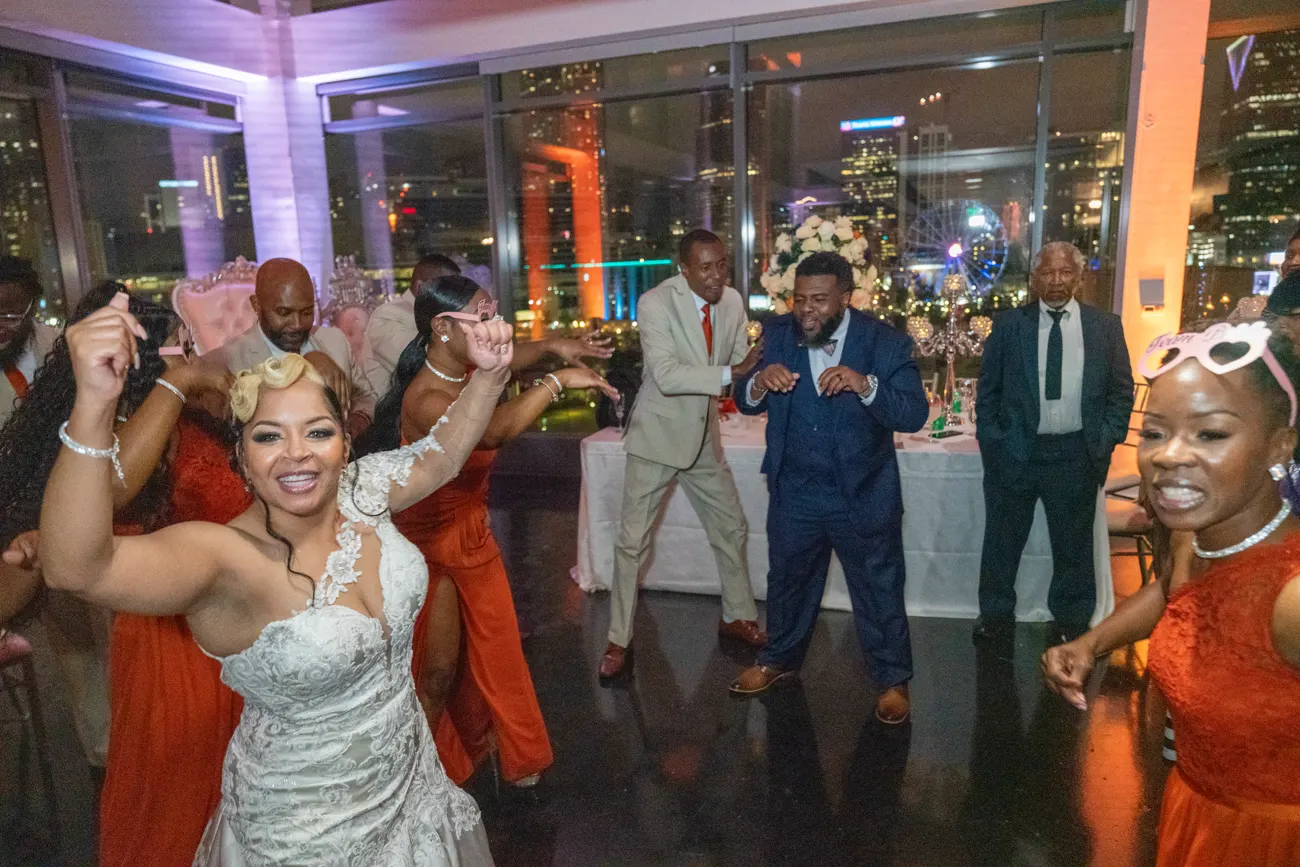
Romantic Slow Songs for the Grown-Ups
Most playlists treat romantic wedding songs like a box to check — one first dance, one parent dance, done. But the real magic happens later, around 9:30 p.m., when the room has been dancing hard and everybody needs a breath. That’s when a sultry, sincere slow set pulls couples back onto the floor two at a time. Your college roommate finds her husband. Your uncle finds your aunt. Suddenly the floor looks like a photo you’ll frame. Here’s how to build that late-evening set for grown-ups — and why it’s the moment nobody plans but everybody remembers.
In this article
Why the late slow set beats the first dance
Your first dance is beautiful, but let’s be honest about what it is. Everybody’s watching. Nobody’s dancing but you. It’s a photo moment, and it should be. The late slow set is something else entirely — it’s the moment your guests get to have their own version of it.
Here’s what happens. The party peaks somewhere around the third or fourth hour. People are warm, a little tired, and genuinely happy. If I drop the energy right then with the right three songs, married couples drift onto the floor without being asked. So do the ones who just started dating. It takes maybe eight seconds.
The trick is that romantic wedding songs at that hour aren’t background music. They’re an invitation. And because the room is already loose, nobody feels awkward about taking it. That’s the whole difference between a slow song at 7 p.m. (empty floor, everyone eating) and the same song at 9:30 (thirty people swaying).
I’ve watched grandparents dance to a song they haven’t heard in forty years while their grandkids filmed it. You can’t schedule that. You can only set the table for it with the right music at the right hour.
Sultry classics that fill the floor
Older songs work here for a simple reason: everybody knows them, and they were written back when slow songs were built for actual dancing. Not swaying — dancing.
Start with the Motown and soul catalog, especially in a Macomb County room where half the guests grew up on it. “Let’s Stay Together” by Al Green is close to undefeated. “At Last” by Etta James still stops conversation. Marvin Gaye’s “Let’s Get It On” gets a laugh and a full floor, which is a rare combination.
Then there’s the smooth-70s lane. “Lovely Day” by Bill Withers, “Just the Two of Us” by Grover Washington Jr. and Bill Withers, and “You Are the Best Thing” by Ray LaMontagne if you want something newer with the same warm feel. These all sit around 70–90 BPM, which is exactly the tempo where two people can hold each other and still move.
Don’t skip the country side either if your crowd leans that way. “Amazed” by Lonestar and “Die a Happy Man” by Thomas Rhett pull people out of chairs across Michigan, every single weekend. Match the songs to the actual humans in the room — not to a list you found online.
Modern romantic songs that feel grown-up
Now, a lot of newer love songs are gorgeous and completely undanceable. They’re written for headphones, not for a room. So I’m picky here, and you should be too.
The ones that work have a real groove under the feeling. “Adorn” by Miguel. “Best Part” by Daniel Caesar and H.E.R. “Slow Dancing in a Burning Room” by John Mayer — grim title, gorgeous song. “Golden Hour” by JVKE lands beautifully right at sunset if your venue has windows facing west.
Then there’s the modern-classic tier that shows up on almost every wedding chart. Ed Sheeran’s “Perfect” and John Legend’s “All of Me” are on every list for a reason, and Billboard’s Hot 100 archives back up just how deep those songs sank into the culture. Use one, not both. Two of them back to back starts to feel like a soundtrack instead of a set.
One more note on newer picks: check the lyrics all the way through. A shocking number of beautiful songs turn out to be about a breakup around the second verse. I’ve caught a few at the last second and I’d rather you catch them first.
A slow song at 7 p.m. is background music. The same song at 9:30 is an invitation — and grown-ups almost always say yes.
The R&B slow jams your guests are waiting for
Here’s what a lot of couples miss when they plan a slow set: they build the whole thing out of wedding songs. Songs about marriage. Songs their parents danced to. All lovely — but the floor really fills when you slide in the R&B your guests loved when they were twenty-two.
Think “Nice & Slow” by Usher. “Untitled (How Does It Feel)” by D’Angelo. “Fallin'” by Alicia Keys. “Adore” by Prince, which in a Michigan room lands somewhere between a love song and a hometown moment. These aren’t wedding songs. That’s exactly why they hit — they’re personal history.
The reaction is always the same. Somebody screams. Somebody else grabs their partner’s hand. Two people who haven’t danced all night are suddenly out there. It’s the most reliable move I have, and it costs you nothing but three minutes of your timeline.
Blend eras while you’re at it. One 90s slow jam, one modern R&B cut, one classic soul record — that little rotation keeps every age group in the room feeling seen. If you want help mapping the whole night’s flow, my wedding DJ services page walks through how I plan each hour.
Key takeaway: Build your slow set out of three or four songs at 70–90 BPM, mix one soul classic with one 90s R&B cut and one modern pick, and place it after the party’s first big peak — not before dinner. That’s when grown-ups actually dance.
How to build the set (order matters)
Three songs is the sweet spot. Four if the room is really into it. Five and you’ve turned your reception into a nap.
Order them like this. Song one should be familiar and mid-tempo, something that says “come on out” without killing the energy — Al Green does this job perfectly. Song two goes deeper and slower, the real romantic peak. Song three starts nudging the tempo back up so I can lift the room into the next dance block without a hard stop.
That third song is the one people forget. Without it, the lights come up emotionally and everybody wanders back to their table. With it, the floor never empties. I usually pick something like “Signed, Sealed, Delivered” or a mid-tempo Bruno Mars cut to bridge it — still warm, but the feet start moving again.
Timing-wise, aim for right after the biggest dance block of the night. The Knot’s reception timeline guide puts most receptions at four to five hours, and in that shape your slow set usually lands about 75 minutes before last call. Late enough that people are loose. Early enough that they’ve still got energy for the final push.
Slow-set mistakes to avoid
The most common one? Going too early. Couples put slow songs during dinner because it feels polite. But nobody dances while holding a fork, so those songs get spent on an empty floor. Save them.
Second mistake: too many in a row. I’ve seen timelines with six slow songs stacked together. By song four, people head for the bar, the bathroom, or their coats. Three is plenty. Trust me on this one.
Third: picking songs only you love. Your personal favorite belongs in your first dance, where it should be exactly what you want. The late set is for the room. If a song means the world to you but nobody else knows it, it’ll clear the floor faster than the lights coming on.
Last one — forgetting the lighting. A slow set under bright white light feels like a school gym. Warm amber or soft pink changes the whole mood in about two seconds, and it costs almost nothing to add. Small detail, huge difference.
Making it work in Clinton Township
Clinton Township rooms have a personality, and it’s worth planning around. The big banquet halls off Hall Road and Gratiot carry sound beautifully but they’re wide, so a slow set can feel spread thin if the floor isn’t defined. I’ll tighten the lighting to pull people toward the center — a simple fix that makes thirty guests look like sixty.
Macomb County crowds also skew multi-generational in the best way. Grandparents, cousins, work friends, kids — all in one room. That’s actually ideal for a slow set, because you’ve got four decades of love songs to pull from and every one of them belongs to somebody out there.
Whatever your venue, the plan stays the same: three or four romantic wedding songs, placed late, mixed across eras, with the lights turned warm. Do that and you’ll get the photo everybody wants — a floor full of couples, nobody watching the clock. Want more ideas before you build your list? There’s plenty in the rest of our music guides, and if you’d like to see how I put a night together, my Clinton Township wedding guide covers it hour by hour. You can also meet your DJ and we’ll talk through your crowd.