

Powering a Backyard Reception: Watts and Outlets
A backyard wedding sounds dreamy right up until the music cuts out mid-song and half the yard goes dark. That’s a backyard power problem, and it’s one of the most common ways a home reception goes sideways. The good news? It’s completely preventable with a little planning. You don’t need to be an electrician — you just need to know roughly how many watts your DJ, lights, and caterer will pull, and how many separate outlets to spread them across. Let’s walk through it step by step so your Canton backyard party runs all night without a single flickering bulb.
In this article
Why backyard power trips up so many parties
Here’s the core issue. A house is wired for normal home life — a fridge, a TV, some lamps. It is not wired to run a full reception’s worth of gear off a couple of patio outlets. So when you plug in a DJ rig, string lights, a coffee urn, and a warming tray all on the same line, the breaker says “nope” and flips.
That’s not a scary problem, though. It’s a math problem. Every outlet feeds off a circuit, and every circuit can only handle so much before it trips. Once you know those limits, you just spread your gear out so no single circuit gets overloaded. Simple.
Good backyard power planning is really just avoiding traffic jams. You don’t want all your heavy stuff crowding one lane. Spread it out, and everything flows. Cram it together, and you get a pileup — usually right when the dance floor is packed. The Knot’s planners flag electricity as one of the most-overlooked pieces of a home wedding, and their backyard wedding guide is a helpful companion as you plan the rest of the day.
Circuits, watts, and amps in plain English
Let’s demystify the numbers, because they’re easier than they look. Most home outlets sit on a 15- or 20-amp circuit. A 15-amp circuit safely handles about 1,440 watts; a 20-amp handles about 1,920 watts. Go past that and the breaker trips to protect your wiring.
Watts are just how much power a device eats. Your phone charger sips a few watts. A coffee urn gulps 1,000 or more. So the trick is adding up the watts on each circuit and keeping the total under that safe ceiling — with a little cushion to spare.
One catch most folks miss: several outlets in one area often share a single circuit. So plugging into two different wall plates doesn’t always mean two separate circuits. That’s why mapping matters, and we’ll get to that. If you want the official safety numbers, the Electrical Safety Foundation keeps a clear plain-language guide.
Powering a backyard party isn’t about being an electrician. It’s about spreading your gear across enough circuits so no single one gets overloaded.
What your DJ and lights actually pull
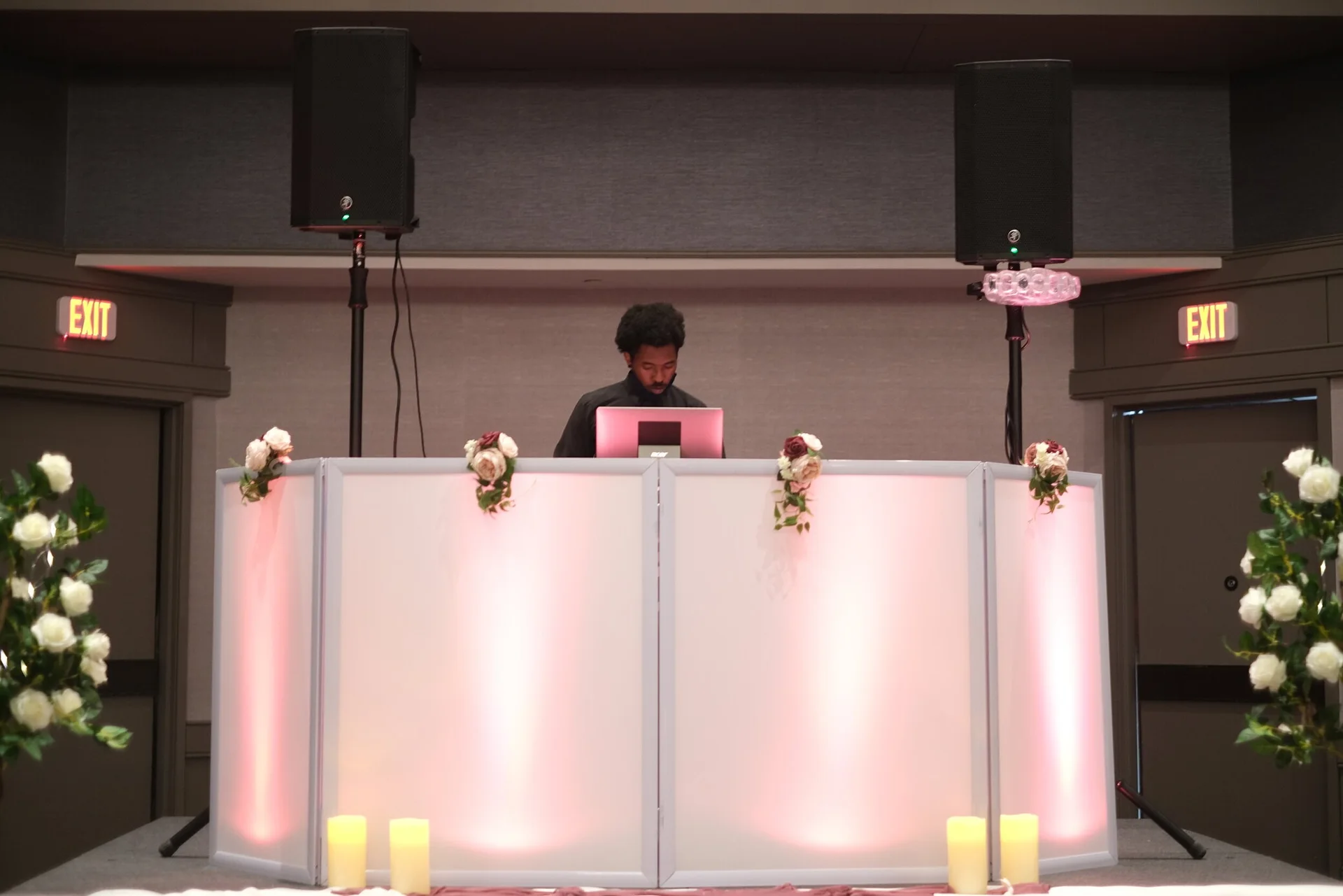
Now the useful part — real numbers. A typical DJ setup for a backyard wedding pulls surprisingly little: speakers, a mixer, and a laptop together usually draw 600 to 1,200 watts. That fits comfortably on one dedicated circuit with room to spare.
Lighting is where it adds up. Modern LED uplights sip power — often just 10 to 25 watts each — so a dozen of them might only pull a few hundred watts total. Older or larger fixtures draw more. If you’re adding a glow to the yard, my uplighting setup runs on efficient LEDs made exactly for events like yours, so they won’t fight your DJ for power.
The real power hogs are usually the caterer and the coffee. Warming trays, urns, and portable ovens each pull 1,000 to 1,500 watts and must sit on their own circuits, far from the DJ. Keep the kitchen gear and the entertainment gear on totally separate lines and you’ve solved half the battle right there.
Key takeaway: Keep your DJ on one circuit, your lights on another, and all catering heat sources on their own separate lines. Add up the watts per circuit, stay under 1,440 (15-amp) or 1,920 (20-amp), and leave a cushion. That’s the whole game.
Here’s what a lot of couples miss: your DJ is your best friend for this. When you book me for a backyard event, I ask about your power before the day and tell you exactly what I’ll plug in and where. A pro won’t just show up and hope — we plan the circuits with you so nothing surprises anyone. Ask any vendor coming to a home how much power they need; a good one will have the answer ready.
Mapping your outlets before the day
Time for a little detective work, and it’s genuinely fun. A week or two before the event, walk your yard and house and find every outlet you might use. Then figure out which breaker controls each one by flipping breakers off one at a time and seeing what dies.
Label them as you go — painter’s tape and a marker work great. “Patio outlet = Breaker 12,” “Garage = Breaker 7,” and so on. Now you can see which outlets share a circuit and which stand alone. This ten-minute map is the single most valuable thing you can do.
With your map in hand, you can assign gear on purpose: DJ on Breaker 12, catering on Breaker 7, lights on the garage line. No guessing on the day, no tripped breakers mid-toast. Just a calm, well-fed grid doing its job quietly in the background.
When you need a generator
Sometimes the house just doesn’t have enough juice, and that’s okay — a generator fills the gap. If your yard is far from the house, or you’re running heavy catering plus a big sound and light rig, a quiet inverter generator is your safety net.
Here’s the key word: quiet. You want an inverter-style generator, not the loud construction kind, or it’ll drown out the music and rattle your guests. Rental companies carry event-grade models that hum softly in the background. Size it to your total watts plus a comfortable 20% cushion.
Talk to your rental company about placement, too. Set it a good distance from the party and behind a fence or shrubs to muffle the sound. Run heavy-duty cords from there to your gear. A generator sounds like overkill until it saves your entire night — then it’s the best money you spent.
Cords, safety, and rain
Let’s cover the safety basics, because a backyard adds a few. Use heavy-gauge outdoor extension cords rated for the load — thin indoor cords can overheat and fail. Thicker is safer, especially over long runs across a lawn.
Tape down or cover any cord that crosses a walking path so nobody trips, and keep connections up off wet grass. If rain is even a maybe, keep every outlet and connection under cover and use outdoor-rated equipment. Water and power are a bad mix, so a little tent or a plastic tote over a connection point goes a long way.
And please, don’t daisy-chain a string of cheap power strips to stretch one outlet. That’s exactly how breakers trip and cords overheat. Spread the load across real circuits instead. When in doubt, ask a licensed electrician to add a temporary outlet or two — it’s cheaper than you’d think and buys total peace of mind.
Putting it together in Canton
So how do you pull it all together? Start with your outlet map, list every vendor’s power needs, and assign each one to a circuit with room to spare. Then confirm it all with your DJ and caterer a week out so there are no surprises.
Whether your reception is in a big Canton backyard off Cherry Hill, a family farm, or a tucked-away garden, the same rules hold: spread the load, keep catering separate, and have a generator ready if the house can’t cover it. Do that and your night glows and grooves without a hiccup. For couples planning locally, my Canton wedding guide covers venues and home-event tips that pair with this checklist.
At the end of the day, power planning is invisible when it’s done right — and that’s the whole point. Your guests should only notice the music, the lights, and the food, never the wiring behind them. For more planning help, browse more reception tips anytime — or meet your DJ and let’s build a backyard party that runs flawless from first song to last.